
The Cost of Volume: Margin Pressures Test BYD’s Domestic Dominance
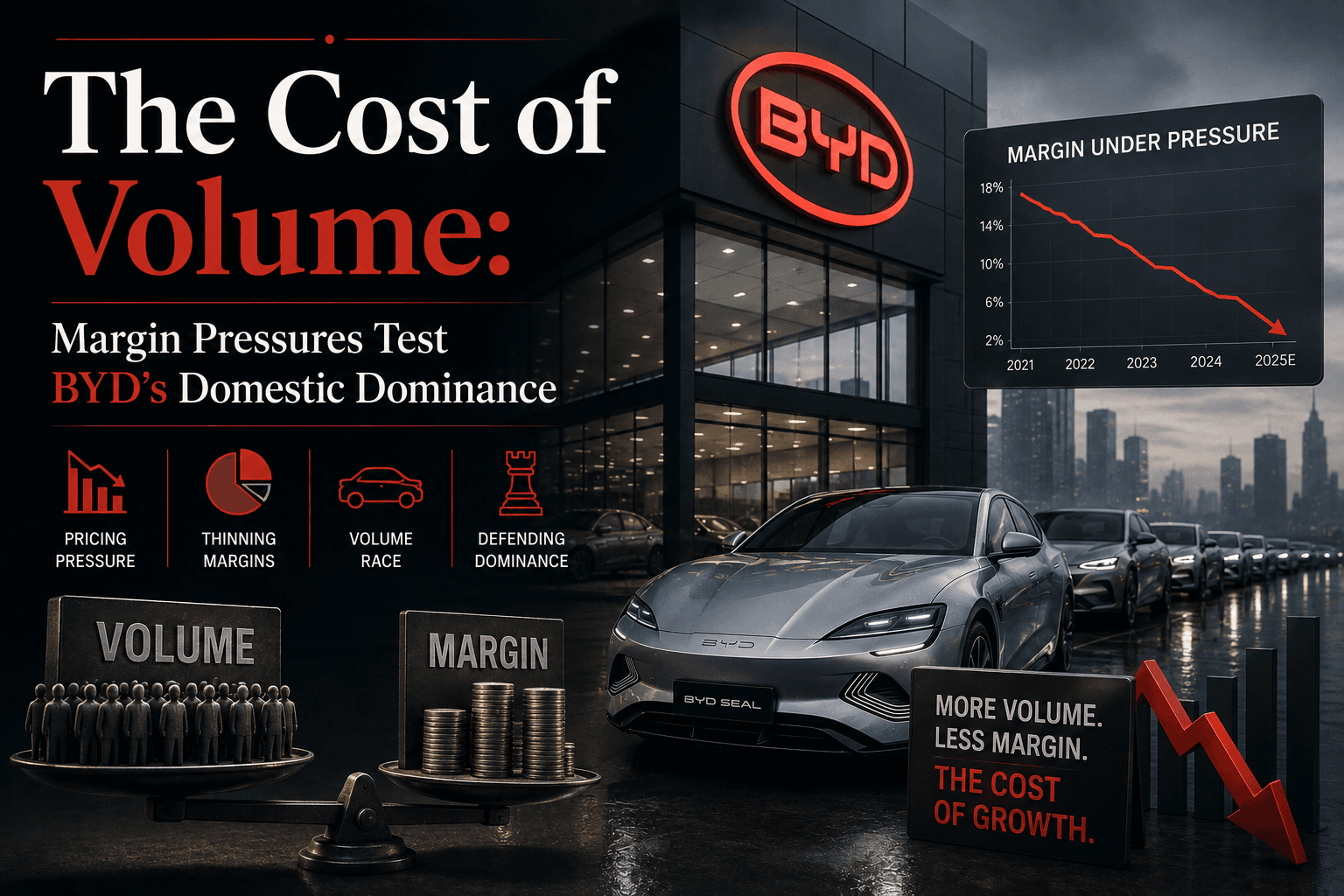
BYD’s first-half earnings bulletin provides clear financial evidence of the intense competitive pressures reshaping China’s automotive industry. While the Shenzhen-based manufacturing giant maintained its dominant market share and expanded total vehicle delivery volumes, its operating and gross margins recorded a significant contraction. The results illustrate the stark reality of the ongoing domestic electric vehicle price war: even the world’s most vertically integrated manufacturer is no longer fully insulated from the profit-eroding effects of sustained retail price discounting.
The Price War Landscape
Over the past eighteen months, China’s passenger vehicle market has experienced an unprecedented pricing conflict. Slowing domestic macroeconomic growth, combined with rapid capacity expansion across legacy automakers and emerging technology-backed EV startups, has generated substantial supply-demand imbalances. Automakers have engaged in aggressive, iterative retail price cuts to defend factory utilization rates and protect showroom traffic.
BYD initiated several rounds of price reductions across its popular plug-in hybrid and pure electric vehicle lineups, using its cost-competitive manufacturing base to pressure higher-cost competitors. However, as rival automakers matched these discounts with aggressive promotions, subsidized insurance packages, and accelerated feature updates, retail pricing drifted lower across all volume segments.
Vertical Integration Versus Price Deflation
BYD’s corporate resilience has historically relied on unmatched vertical integration. By manufacturing its own lithium-iron-phosphate Blade batteries, power semiconductors, drive motors, and automotive software in-house, the company captures supplier margins internally and maintains production costs significantly below those of traditional automakers.
However, the latest earnings bulletin demonstrates the physical limits of vertical cost absorption:
Raw material savings from declining upstream lithium carbonate prices have been fully passed on to end consumers through vehicle price cuts, eliminating a key source of margin buffer.
Factory unit economics have encountered diminishing returns, where incremental volume gains no longer generate sufficient scale efficiencies to offset retail price cuts.
Increased research, development, and marketing expenditures required to support new model launches have added overhead costs across the operating balance sheet.
Impact Across the Automotive Value Chain
The margin compression at the industry’s lowest-cost producer signals severe distress for the broader automotive ecosystem. Smaller electric vehicle startups that lack proprietary battery manufacturing or sufficient domestic volume are experiencing accelerating cash burn, forcing them to rely on emergency capital injections or consider corporate restructuring.
Automotive component suppliers are facing intense demands for price concessions from original equipment manufacturers, leading to margin erosion and delayed capital investments across the Tier-1 and Tier-2 supply chains. For domestic consumers, the price war has delivered exceptional affordability and high technological specifications, but it has simultaneously caused rapid depreciation of used vehicle values, destabilizing auto-financing portfolios.
Export Strategy and Geopolitical Countermeasures
To escape domestic margin compression, BYD is accelerating its international export strategy and localized overseas manufacturing. Vehicles exported to Southeast Asia, Latin America, and the Middle East carry significantly higher retail price points and wider profit margins than identical models sold in the fiercely contested Chinese domestic market.
However, this international expansion faces severe geopolitical barriers. The implementation of protective tariffs and import restrictions across North America and the European Union limits the volume of vehicle shipments that can be redirected to high-margin advanced economies. Establishing localized assembly plants in overseas markets requires substantial capital outlays and exposes the company to complex foreign labor, environmental, and regulatory environments.
The Inevitable Industry Consolidation
BYD’s earnings compression confirms that China’s electric vehicle industry has entered a brutal consolidation phase. Market share preservation through aggressive price competition is exhausting corporate balance sheets across the entire industrial base. While BYD possesses the scale, liquidity, and technological depth required to survive this prolonged margin squeeze, the results confirm that the era of effortless profitability in China’s domestic EV sector has officially come to an end.