
Strategic Assembly: New Delhi Approves the Dixon-Vivo Manufacturing Venture
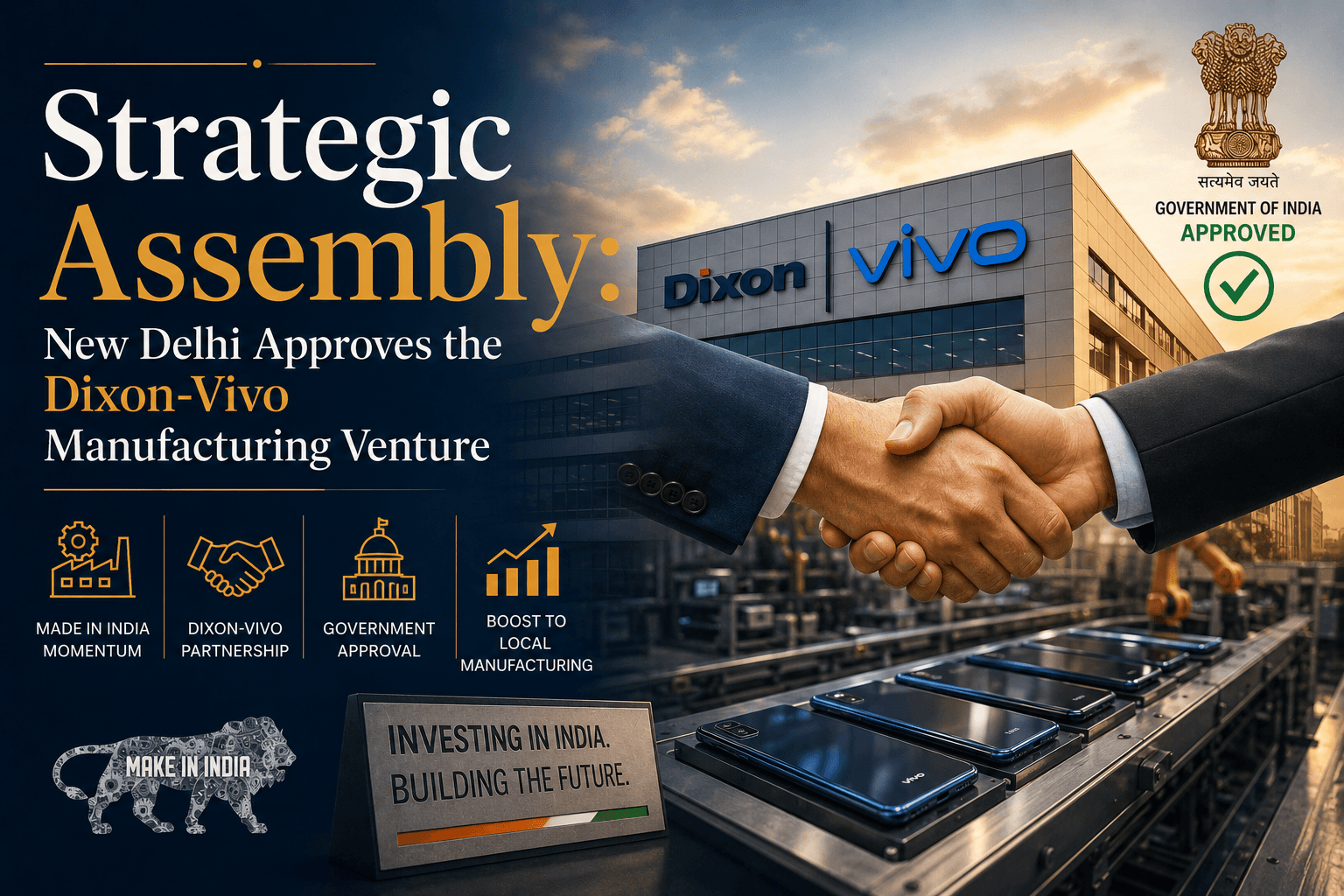
The Indian government has officially granted regulatory clearance for the joint venture between domestic contract manufacturer Dixon Technologies and Chinese smartphone manufacturer Vivo. The approval resolves months of regulatory review and establishes an operational model for foreign consumer electronics firms seeking to maintain large-scale manufacturing footprints in India. By requiring significant local equity participation and operational integration, the transaction balances national industrial policy goals with global supply chain realities.
The Evolution of Local Electronics Manufacturing
India’s electronics manufacturing landscape has undergone a profound transformation under the production-linked incentive framework. While early stages focused primarily on simple final assembly, government policy has progressively tightened domestic value addition criteria, encouraging local sourcing of components, sub-assemblies, and printed circuit board assemblies.
Simultaneously, regulatory authorities have subjected foreign consumer electronics brands, particularly those based in China, to heightened compliance scrutiny regarding corporate ownership structures, domestic distribution networks, and tax liabilities. To navigate these regulatory boundaries while protecting their established market share, multinational hardware brands have turned to structured partnerships with established Indian electronic manufacturing services providers.
Joint Venture Mechanics and Industrial Realities
The Dixon-Vivo venture represents an alignment of operational capabilities and regulatory compliance. Dixon Technologies brings localized operational infrastructure, deep relationships with state and central industrial bodies, and eligibility for domestic manufacturing incentives. Vivo provides established component supply chains, proprietary design architectures, and an entrenched consumer retail footprint across tier-two and tier-three Indian cities.
Under the cleared structure, the manufacturing operations will be managed locally, ensuring that economic value creation, supply chain contracting, and production management remain anchored within the domestic corporate framework. This shift enables Dixon to expand its production volumes and scale efficiencies, while allowing Vivo to insulate its assembly pipeline from cross-border regulatory interruptions.
Impact on Supply Chains and Market Competition
The regulatory green light delivers clear benefits across multiple industrial tiers:
Domestic component suppliers gain predictable, high-volume orders for plastics, packaging, mechanical parts, and passive electronic components.
Contract manufacturing peers face heightened competitive pressure as Dixon consolidates its position as the preeminent domestic manufacturing partner for global hardware brands.
Retail consumers benefit from continuous product availability and localized pricing stability, avoiding potential import tariffs or logistical disruptions.
For policymakers, the partnership serves as a proof of concept. It demonstrates that foreign hardware firms can continue operating at scale in the domestic market provided they integrate into domestic manufacturing structures and transfer operational oversight to local corporate entities.
Execution Risks and Value Addition Challenges
The long-term success of the venture depends on the rate at which it increases real domestic value addition. Basic assembly delivers thin profit margins and remains vulnerable to external component price shocks. If the venture fails to transition from surface-mount assembly to localized sourcing of advanced components—such as display modules, camera assemblies, and semi-processed silicon—the macroeconomic gains for the domestic economy will remain limited.
Additionally, any sudden shift in bilateral trade policies or changes to the production-linked incentive parameters could alter the commercial calculations underpinning the factory expansion plans.
A Blueprint for Cross-Border Tech Manufacturing
The clearance of the Dixon-Vivo partnership establishes a practical precedent for international corporate strategy within emerging manufacturing hubs. Complete supply-chain self-sufficiency is difficult to achieve in the short term, but targeted joint ventures allow host economies to capture manufacturing capacity while giving global brands operational certainty. As global supply chains continue to realign, this model of localized corporate integration will likely define the next phase of electronics manufacturing across emerging markets.