
The Hidden Cost of America’s New Tariff Economy
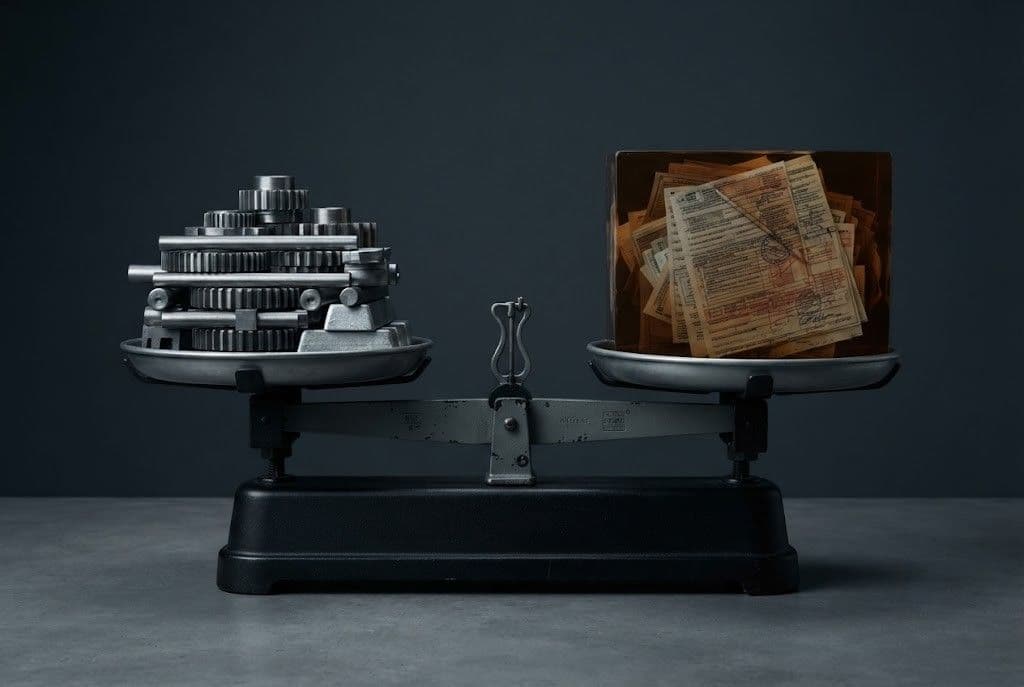
America’s new tariff regime is changing more than the price of imported goods. It is changing the calculations businesses make about where to source components, where to build factories, how much inventory to hold and how much of a higher cost can ultimately be passed to customers.
That adjustment is already visible in the economy. The Federal Reserve reported in July that increases in tariffs on U.S. goods imports had pushed up domestic prices for some consumer goods, while its researchers have found that households exposed to tariff increases reduced spending and shifted toward cheaper alternatives.
The central economic question is therefore not simply whether tariffs make imported products more expensive. It is who ultimately absorbs the cost—and what happens to economic decisions as companies and consumers respond.
A tax that moves through the supply chain
A tariff is collected from the importer when goods enter the United States. But the importer is rarely the final economic bearer of the cost.
Consider a manufacturer importing a component that is subject to a tariff. The company has several choices: absorb the additional expense, negotiate a lower price with its supplier, find another source, redesign the product, relocate production or raise its selling price.
Each option carries consequences.
If the company raises prices, the tariff becomes visible to consumers. If it absorbs the cost, profit margins decline. If it switches suppliers, the company may incur new logistics and qualification costs. If it relocates production, it must commit capital to a decision whose benefits may take years to materialise.
The result is an economic cost that can be considerably broader than the customs payment itself.
The Federal Reserve’s research on 2025 tariffs estimated that only 15% to 20% of tariff costs were passed directly through to prices in the categories it studied, while businesses and consumers adjusted their behaviour in other ways. At the average level of tariff exposure, prices increased by 1% to 2%, while spending fell by roughly 4%.
That distinction matters. A tariff can affect economic activity even when its entire cost does not appear as a higher retail price.
The adjustment burden on businesses
Large companies may have more options than smaller firms.
A multinational manufacturer can negotiate with several suppliers, shift production between countries or redesign its sourcing network. A smaller importer may have little bargaining power and fewer alternatives.
For companies with thin margins, even a relatively modest increase in input costs can change the economics of a product line.
This can encourage businesses to build domestic capacity. That is one of the intended mechanisms of tariffs: making imported goods relatively more expensive can improve the competitive position of domestic producers.
But replacing imports is not instantaneous.
A factory requires land, machinery, workers, permits, suppliers and financing. Some specialised components may not have a viable domestic substitute. Companies may therefore continue importing despite higher tariffs because the alternative would be even more expensive.
This creates a second-order cost: businesses may invest not because a new facility is the most productive option, but because trade policy has altered the relative economics of production.
Consumers feel the effects differently
The distribution of tariff costs also matters.
Households with substantial discretionary income may respond to higher prices by delaying purchases or switching brands. Households with less flexibility have fewer choices, particularly when tariffs affect necessities or widely used products.
The Federal Reserve's July monetary-policy report noted that lower-income households are particularly sensitive to food and energy costs because those categories represent a larger share of their spending.
The effect can therefore occur without a dramatic increase in headline inflation. A household might simply buy a cheaper appliance, postpone replacing a vehicle or reduce spending elsewhere to accommodate higher prices.
That behavioural response matters to businesses. Lower sales volumes can offset some of the additional revenue created by higher prices, leaving companies with a difficult choice between protecting margins and protecting market share.
The investment cost of uncertainty
Perhaps the least visible cost is uncertainty.
Companies making multibillion-dollar investment decisions need to estimate costs over many years. If tariff rates, exemptions, trading relationships or rules of origin can change during that period, the expected return on a factory or supply-chain project becomes harder to calculate.
That can have two opposite effects.
Some companies may accelerate investment in the United States to reduce exposure to future tariffs. Others may delay investment until they have greater clarity about the rules.
The difference depends on the company's industry, supply chain and ability to relocate production.
Recent trade tensions between the United States and Canada illustrate the problem. The possibility of substantially higher tariffs on Canadian automobiles and parts has raised concerns about disruption to one of North America's most integrated manufacturing networks.
For manufacturers operating across borders, changing tariff policy can therefore become an operational risk rather than simply a tax consideration.
Protection has winners, too
The costs do not mean tariffs have no benefits.
Domestic manufacturers competing directly with imports can gain pricing power and market share. Investment may become more attractive in sectors where foreign competition had previously limited domestic production. Tariff revenue can also provide the federal government with additional receipts.
The Tax Foundation estimates that current U.S. tariffs apply to a large share of goods imports and could generate substantial federal revenue over the coming decade, although its modelling also estimates a reduction in long-run economic output.
The trade-off is therefore between protecting particular domestic activities and accepting higher costs elsewhere in the economy.
The question is whether the protected capacity generates enough productivity, employment and investment to compensate for the costs imposed on downstream businesses and consumers.
What happens next
The longer-term outcome will depend heavily on how businesses respond.
If companies use tariff protection to invest in productive domestic capacity, develop suppliers and improve efficiency, the policy could contribute to a more resilient industrial base. If companies mainly respond by raising prices or moving production between countries without improving productivity, the economic benefits could be smaller.
Technology will also matter. The Boston Federal Reserve recently reported that productivity gains in tariff-exposed industries helped firms absorb some higher input costs rather than passing them entirely to consumers.
Trade relationships will be another variable. Retaliatory tariffs can reduce access to foreign markets for American exporters, while exemptions or new agreements can lower costs unexpectedly.
The hidden cost of the tariff economy is therefore not a single number. It is the accumulation of thousands of decisions made by importers, manufacturers, retailers, investors and households.
America may gain domestic production in some areas while losing efficiency in others. Some businesses will invest; others will delay. Some consumers will pay more; others will simply buy less.
The defining question is whether the new tariff structure ultimately encourages a more productive American industrial base or merely redistributes costs across the economy. The answer will depend less on the headline tariff rate than on what businesses do with the incentives that follow from it.