Prescription Drug Prices Are Falling. The U.S. Drug Bill Is Not
For the first time in years, parts of the U.S. prescription-drug market are showing a direction that patients and policymakers have long wanted: prices are falling. The U.S. Bureau of Labor Statistics reported that prescription-drug prices fell 3.1% in the year through July 2026, including a 0.8% decline in July alone.
That sounds like a straightforward victory for affordability. It is not.
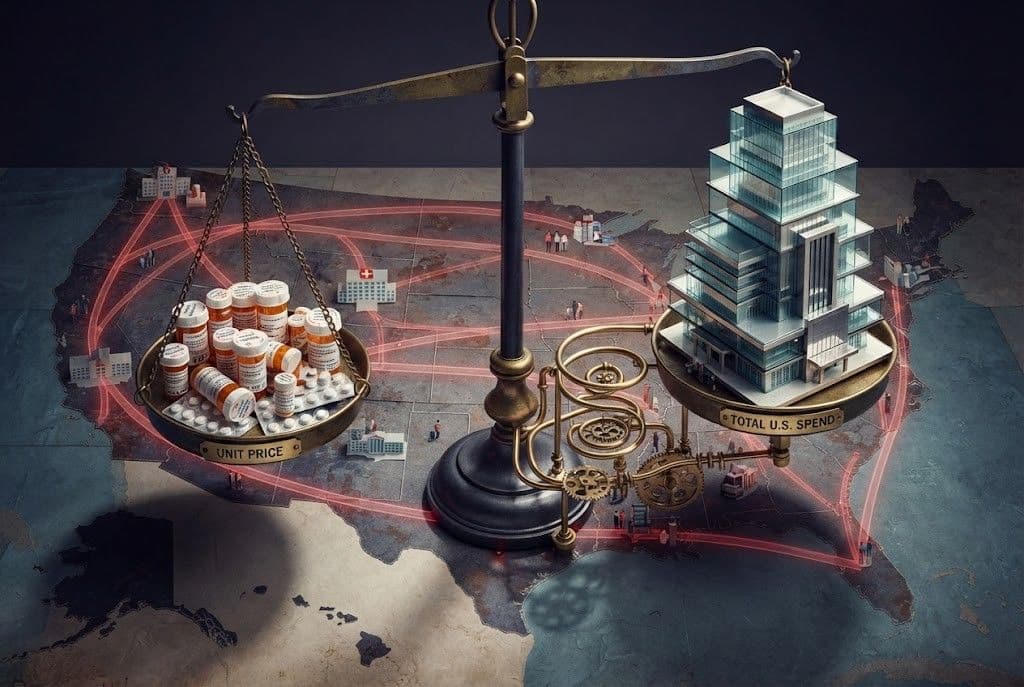
The price of an individual medicine, the amount an insurer or government program ultimately pays, a patient's out-of-pocket bill and total national drug spending are different measures. They can move in opposite directions. In 2025, U.S. medicine spending at net manufacturer prices rose 10.6% to $606 billion, according to IQVIA, even as some parts of the market experienced pricing pressure.
The apparent contradiction reveals one of the central problems in understanding American drug costs: lower prices do not automatically mean a lower drug bill.
The price Americans see is not always the price that matters
The U.S. pharmaceutical market operates through several layers of pricing. Manufacturers establish list prices, insurers and pharmacy-benefit managers negotiate discounts and rebates, pharmacies receive payments, and patients face cost-sharing determined by their insurance plans.
As a result, the list price of a medicine can differ substantially from its net price after discounts. The Congressional Budget Office has previously documented a widening gap between retail and net prices for brand-name drugs as rebates and other payments to insurers and government programs increased.
That makes headline measures of drug inflation useful but incomplete.
The BLS consumer-price index measures prices paid by consumers and therefore captures an important part of the affordability question. But it does not describe the entire flow of money through the pharmaceutical supply chain.
For patients, the distinction is especially important. A manufacturer can reduce a medicine's effective price while an insured patient still faces a high deductible or coinsurance obligation. Conversely, a negotiated price may reduce government spending without producing an equivalent reduction in every patient's pharmacy bill.
Why prices are coming under pressure
Several forces are pushing in the direction of lower prices.
Generic competition remains one of the most powerful. Once patents and other market protections expire, lower-cost alternatives can enter the market and erode the pricing power of established brands. Biosimilars are creating a similar dynamic for some biologic medicines, although competition in that market is more complicated than the traditional generic-drug model.
Patent expiries are also expected to exert downward pressure on U.S. medicine spending over the coming years. IQVIA forecasts that spending growth through 2030 will be moderated by patent expiries and other pricing pressures, even as demand for new medicines continues to expand.
Government intervention is another factor.
January 2026 marked the first year in which negotiated prices under Medicare's new drug-price negotiation program took effect. The Centers for Medicare & Medicaid Services negotiated maximum fair prices for the first 10 selected medicines. CMS estimated that, had those prices applied in 2023, they would have reduced net covered prescription-drug costs for those medicines by about $6 billion.
The program is expanding, with additional medicines selected for subsequent negotiation cycles.
The Trump administration has also pursued separate agreements with pharmaceutical manufacturers intended to bring selected U.S. prices closer to prices in other developed countries. Those agreements, together with the TrumpRx platform, are adding another layer to an already complicated pricing system.
Falling prices can coexist with rising spending
The biggest reason is utilization.
If a medicine becomes cheaper but many more people use it, total spending can still rise. The same applies when patients shift from inexpensive older medicines toward newer, more expensive therapies.
That is already visible in the broader U.S. market. Americans used a record 210 billion days of medicine therapy in 2025, up 1.5% from the previous year, while net medicine spending increased by $58 billion. IQVIA attributed much of the spending increase to protected branded medicines, particularly in oncology and immunology, alongside substantial growth from newer diabetes and obesity treatments.
The economics therefore depend on more than the price of each prescription. A drug can become cheaper while the healthcare system spends more because patients are receiving more treatment, living longer with chronic diseases or switching toward therapies that deliver greater clinical value but carry higher costs.
The affordability problem has moved to insurance design
For employers and insurers, the challenge is increasingly about the mix of medicines being used.
IQVIA reported that commercial-insurance out-of-pocket costs rose 5% in aggregate in 2025 and were 37% higher than five years earlier. The increase reflected both greater prescription volume and a shift toward higher-cost medicines. Medicare beneficiaries, by contrast, saw aggregate out-of-pocket spending decline in 2025 following the introduction of the Part D annual out-of-pocket cap.
This helps explain why a national measure showing lower prescription prices may not feel like a major improvement to every household.
Employers may still face higher pharmacy budgets if employees use more expensive therapies. Insurers may respond through formularies, prior authorization, negotiated networks or different cost-sharing structures. Workers can consequently experience different financial outcomes even when the underlying price of a medicine falls.
The pharmaceutical industry's incentives are also changing. Lower prices can increase access and potentially expand volumes, but manufacturers argue that returns from successful medicines help finance research into future therapies. IQVIA's recent analysis notes that brand medicines often generate a significant share of their lifetime revenue later in their market life, making the timing and scale of price controls potentially relevant to investment decisions.
What happens next
The U.S. drug market is likely to become more segmented rather than simply cheaper.
Generic and biosimilar competition, patent expiries and government negotiations should create downward pressure in some established categories. At the same time, new medicines—particularly in oncology, immunology, obesity, diabetes and other specialty fields—could keep pushing spending upward.
IQVIA expects U.S. medicine spending to grow between 4.5% and 7.5% annually through 2030 after discounts and rebates, compared with 6% to 9% on a list-price basis.
That forecast illustrates the distinction policymakers and businesses increasingly have to make. Lower unit prices can improve affordability, but controlling total healthcare spending requires attention to utilization, treatment mix, insurance design and the prices of hospitals and other medical services as well.
The broader lesson is that the U.S. pharmaceutical debate cannot be reduced to whether drug prices are rising or falling. The more consequential question is where the savings occur, who captures them and whether patients actually face lower costs at the point of care.
For households, employers and governments, that distribution matters almost as much as the headline price itself. A cheaper prescription is meaningful only when the savings survive the journey through the complex machinery of American healthcare and reach the person who needs the medicine.